
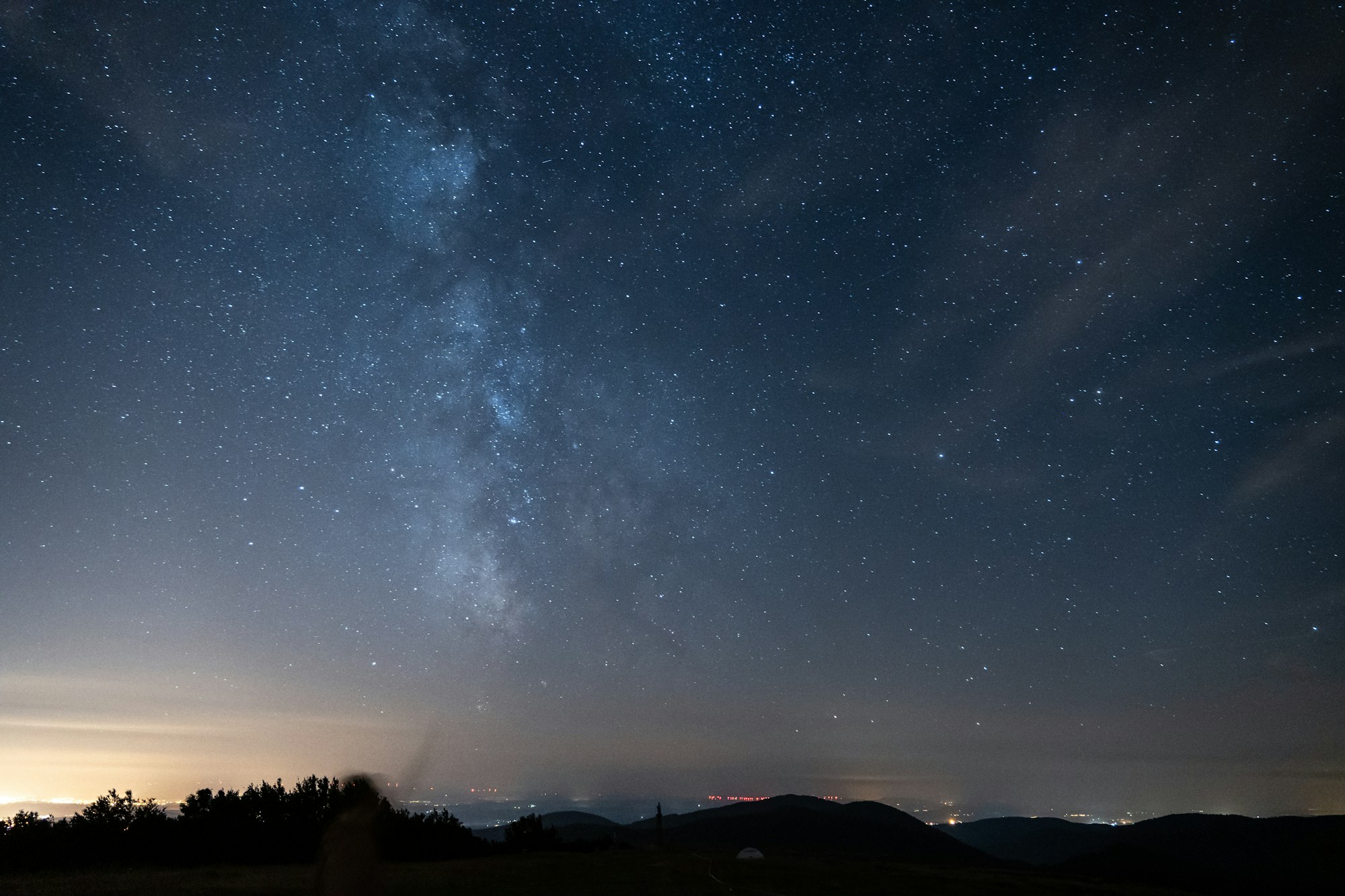
September 2026 is shaping up to be an exciting month for anyone who enjoys looking up at the night sky. Whether you are an experienced amateur astronomer with a telescope or simply curious about what you can see without any equipment, there are plenty of celestial events worth watching.
This month brings a particularly brilliant Venus, a beautiful Harvest Moon, changing planetary positions, opportunities to spot distant galaxies, and several deep-sky objects that become interesting targets for binoculars and telescopes.
The September sky also marks an important seasonal transition. On September 22, the September equinox will officially arrive, bringing autumn to the Northern Hemisphere and spring to the Southern Hemisphere.
Some events are easy to observe with the naked eye, while others require darker skies or optical equipment. Here are some of the highlights to put on your astronomy calendar this month.
Venus Reaches Peak Brilliance
One of the easiest celestial objects to find in September will be Venus.
The planet has been appearing as a bright evening object, and on September 18 it reaches its peak brilliance during this particular evening apparition. Its brightness makes Venus one of the most obvious objects in the sky after the Sun and Moon.
Venus is often called the "Evening Star," although it is not actually a star. It is a planet reflecting sunlight, and its thick atmosphere makes it exceptionally bright when its position relative to Earth and the Sun is favorable.
For observers, the best opportunity comes shortly after sunset, when Venus can be found relatively low in the western part of the sky.
Because Venus is gradually moving closer to the Sun's apparent position in the sky, it will become increasingly difficult to observe later in the month. That makes the first and middle parts of September particularly worthwhile for anyone hoping to see it.
You do not need a telescope. From a location with a reasonably clear western horizon, Venus should be easy to identify as an extremely bright point of light.
A small telescope can reveal something even more interesting: Venus goes through phases, much like the Moon. Depending on its position in its orbit, it can appear as a crescent, half-lit disk, or a more nearly full disk.
The Moon Becomes a Guide to the Night Sky
The Moon will play an especially useful role in September because it can help observers locate other celestial objects.
From September 14 through 20, the Moon passes through a region of the evening sky containing several interesting landmarks. NASA recommends using the Moon as a guide to find Antares and the distinctive stars of Sagittarius, whose pattern is often called the "Teapot."
About an hour after sunset, observers can look toward the southern sky for the Moon and its nearby celestial companions.
Antares is particularly easy to recognize because of its reddish-orange appearance. It is one of the brightest stars in the night sky and marks the heart of Scorpius, the scorpion.
Under dark skies, this region can become even more spectacular. Sagittarius lies toward the direction of the center of the Milky Way, where the density of stars increases dramatically.
In places far from city lights, observers may be able to see the Milky Way stretching across the sky as a faint, cloudy band.
This is a good example of why astronomy does not always require expensive equipment. Sometimes the biggest improvement comes simply from getting away from artificial light.
September 18: Venus at Its Brightest
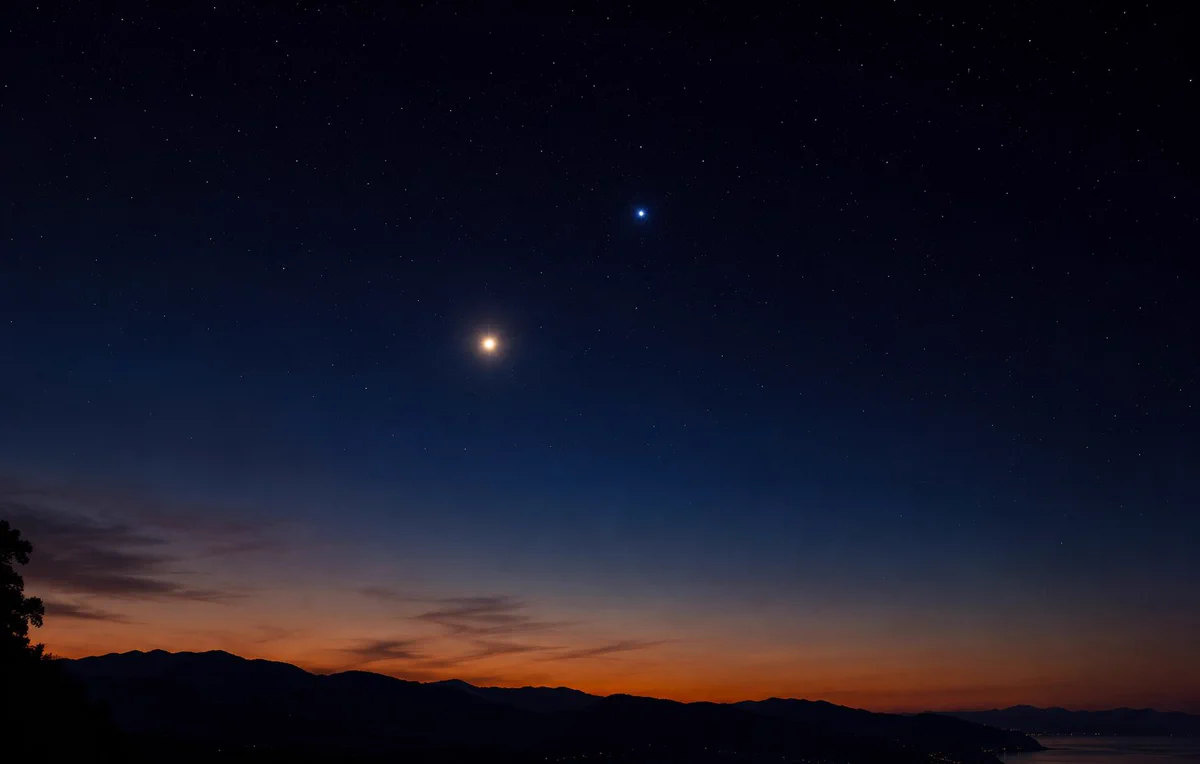
September 18 deserves a special mark on the calendar.
On this evening, Venus reaches peak brilliance for its current evening appearance.
The planet should stand out against the twilight sky, making this one of the month's easiest astronomical events for beginners.
Try to find a location with an unobstructed view toward the west. Begin looking shortly after sunset, but avoid searching too close to the Sun itself. Once the Sun has disappeared below the horizon and the sky begins to darken, Venus should become increasingly obvious.
Photography is also possible with a smartphone, especially if Venus is included in a landscape showing trees, buildings, mountains, or another foreground object.
A telescope is not necessary to appreciate the event, but through a telescope Venus may appear as a small illuminated disk rather than a simple point of light.
September 22: The Equinox Arrives
Another important event occurs on September 22, when the September equinox takes place.
The equinox is one of the two points in Earth's annual orbit when neither hemisphere is tilted strongly toward or away from the Sun. Around the equinox, day and night are approximately equal in length, although the exact balance varies depending on location and atmospheric effects.
For people in the Northern Hemisphere, the September equinox marks the beginning of astronomical autumn.
For observers in the Southern Hemisphere, including much of South America, it marks the beginning of astronomical spring.
The equinox is also an excellent reminder that the night sky changes throughout the year because Earth is constantly moving around the Sun. As the seasons change, different constellations become visible at different times of night.
So the September sky is not simply a repeat of what appeared above us a few months earlier. It is part of a constantly changing celestial landscape.
September 26: The Harvest Moon Meets Saturn and Neptune
The full Moon on September 26 will be one of the month's most recognizable sights.
This full Moon is known as the Harvest Moon, a traditional name associated with the full Moon occurring close to the autumnal equinox in the Northern Hemisphere. This year, it will appear near Saturn and Neptune in the sky.
The Harvest Moon has fascinated people for centuries, partly because its appearance near the horizon can create an impressive visual effect.
When the Moon is rising, it may look unusually large or orange. The Moon is not actually much larger at the horizon. The apparent size change is primarily a visual phenomenon known as the Moon illusion.
The orange or reddish color, meanwhile, is caused by Earth's atmosphere. When the Moon is low in the sky, its light travels through a greater amount of atmosphere before reaching an observer. Shorter wavelengths of light are scattered more strongly, allowing warmer colors to become more noticeable.
This makes moonrise a particularly attractive time for photography.
Saturn Will Be a Great Telescope Target
Saturn remains one of the most rewarding planets to observe with a telescope in September.
The planet's famous rings are one of the most recognizable sights in amateur astronomy. Even a relatively modest telescope can reveal the ring system, although the level of detail depends on the instrument, atmospheric conditions, and magnification.
On September 26, Saturn will appear near the Harvest Moon, providing an interesting combination for skywatchers.
The challenge is that the bright full Moon can make some nearby faint objects more difficult to see. Saturn itself, however, is bright enough to remain an excellent target.
If you want to photograph Saturn, a telescope with a suitable planetary camera or even a smartphone adapter can produce surprisingly detailed results under good conditions.
Jupiter and a Rare Lunar Encounter
Jupiter is another major planetary target in September.
The giant planet is becoming increasingly prominent in the predawn sky, and one of the month's notable events occurs on September 8, when the Moon passes in front of Jupiter from certain locations on Earth. This type of event is called a lunar occultation.
An occultation happens when one celestial object passes directly in front of another from the observer's point of view.
Because the Moon is relatively close to Earth, it can appear to move across the background stars and planets. When its disk crosses Jupiter, the giant planet can temporarily disappear behind the Moon before emerging again.
The exact visibility of such an event depends strongly on location. Not everyone on Earth will see Jupiter disappear behind the Moon, so local sky charts and observing information are important for determining whether the event is visible from a particular location.
Even when the occultation itself is not visible, Jupiter remains a rewarding target during September.
Through binoculars, observers with steady hands or a tripod may be able to detect some of Jupiter's largest moons. With a telescope, the planet's cloud bands and the four Galilean moons become much easier to observe.
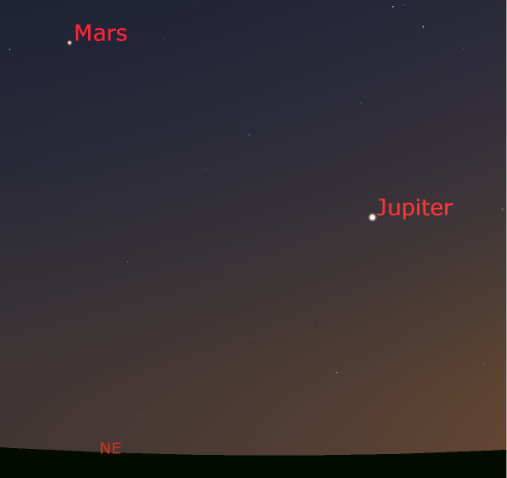
Mars Continues Its Morning Appearance
Mars is also visible during September, although it is not an evening object like Venus.
The Red Planet can be found in the predawn sky, gradually becoming brighter as the month progresses. During September, Mars moves through the constellations Gemini and Cancer, creating several interesting configurations with nearby stars.
On September 25, Mars forms a notable arrangement with Castor and Pollux, the two bright stars traditionally associated with the constellation Gemini.
Mars can be identified by its subtle reddish-orange color. Unlike stars, however, it usually appears as a steadier point of light because planets are much closer to Earth and have a measurable apparent disk.
The best time to observe Mars is before sunrise, so this is an event for early risers.
Mercury Makes a Brief Appearance
Mercury is one of the more difficult planets to observe because it never moves very far from the Sun in our sky.
During the final week of September, Mercury becomes visible low in the west-southwestern sky after sunset under favorable conditions.
Finding Mercury requires a clear horizon and good timing. Because the planet remains close to the Sun's apparent position, it can disappear into twilight quickly.
For beginners, Venus can serve as a useful reference point when searching for Mercury, although the exact appearance will depend on the observer's latitude and local conditions.
Mercury is a particularly interesting target because it is the smallest planet in the Solar System and the closest planet to the Sun.
Explore the Andromeda Galaxy
September is also a fantastic month for exploring objects beyond the Solar System.
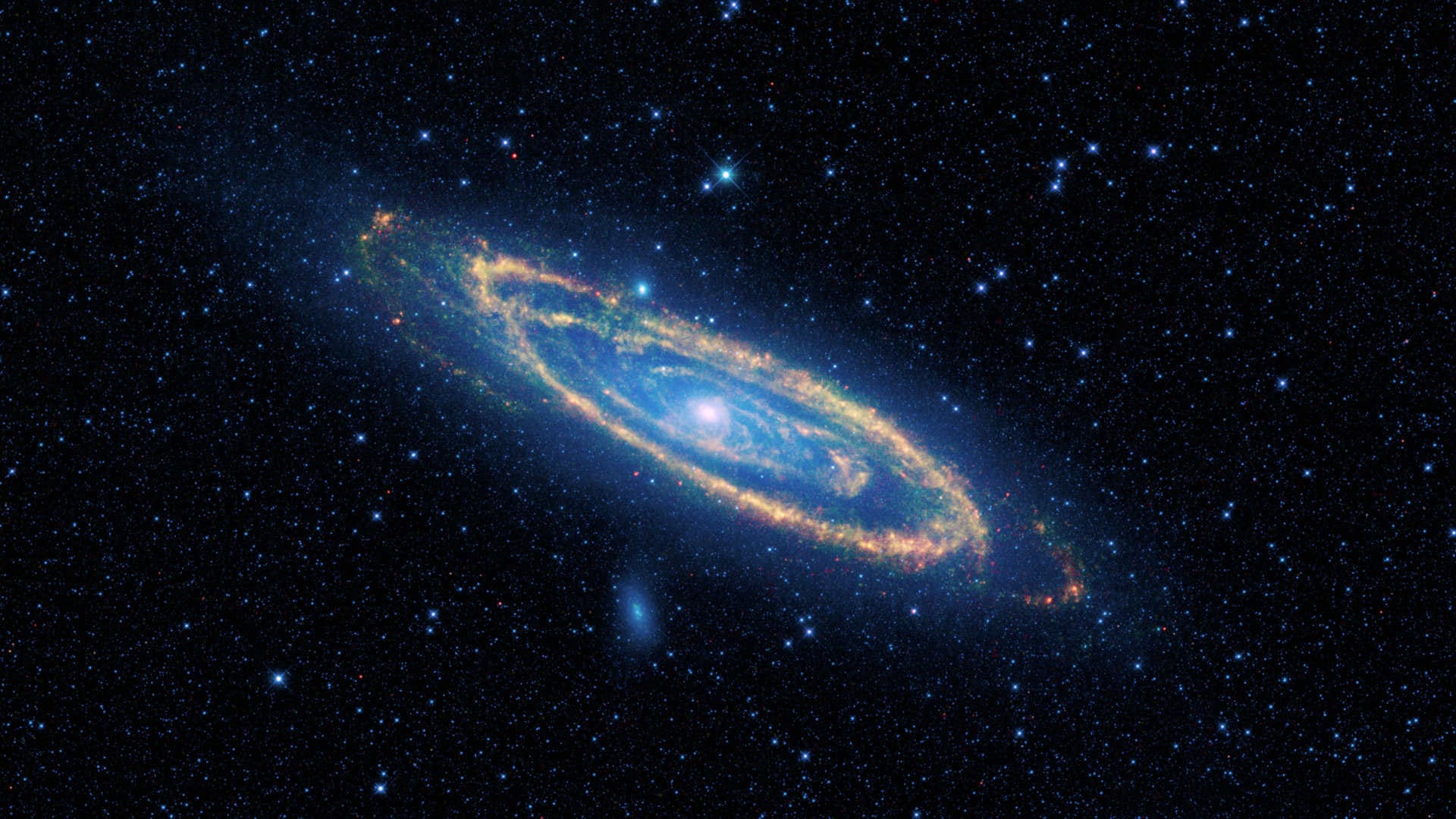
One of the best-known targets is the Andromeda Galaxy, also known as M31.
Located roughly 2.5 million light-years away, Andromeda is the nearest major galaxy to our own Milky Way. It is enormous, containing hundreds of billions of stars.
Under dark skies, the galaxy can sometimes be seen without optical equipment as a faint, diffuse patch of light. Binoculars make it much easier to find, while a telescope can reveal more of its structure.
Andromeda is particularly fascinating because it is not simply an isolated island of stars. It is part of the Local Group, the collection of galaxies gravitationally associated with the Milky Way.
The sight of Andromeda is also a reminder of just how far astronomical observation can take us. The light reaching your eyes began its journey millions of years ago.
When you look at Andromeda, you are literally seeing an ancient image of another galaxy.
The Triangulum Galaxy Is Another September Target
The Triangulum Galaxy, or M33, is another fascinating target for observers with dark skies.
It is smaller and fainter than Andromeda, which makes it more challenging to observe. However, binoculars or a telescope can make the search much more rewarding.
M33 is also part of the Local Group and is a spiral galaxy containing enormous regions of active star formation.
Because galaxies such as M31 and M33 are relatively faint and spread their light over a large area, high levels of light pollution can make them extremely difficult to see.
For this type of observation, a dark location can be more valuable than a very expensive telescope.
Deep-Sky Objects for Telescope Owners
September offers plenty of targets beyond the brightest planets and galaxies.
Observers using binoculars or telescopes can explore star clusters and planetary nebulae, including objects such as the Double Cluster in Perseus, the Owl Cluster, and the Blinking Planetary Nebula. More advanced observers can also search for the Blue Snowball Nebula, NGC 7662, and the Saturn Nebula, NGC 7009.
Planetary nebulae are particularly interesting because, despite their name, they have nothing to do with planets.
They are clouds of gas and dust produced during the late stages of evolution of certain stars. Their often colorful and unusual shapes are the result of material being expelled from a dying star and illuminated by the hot stellar remnant left behind.
These objects can be difficult to appreciate from a brightly lit city, but under dark skies they become excellent targets for patient observers.
Don't Forget the Comets
September also offers opportunities to search for comets, including 10P/Tempel 2 and 161P/Hartley-IRAS under favorable observing conditions.
Unlike Venus or Jupiter, comets are not always obvious to the naked eye. Their visibility depends on their brightness, position in the sky, distance from Earth and Sun, and the amount of light pollution at the observing site.
A pair of binoculars can be extremely useful when searching for a comet.
Comets are particularly rewarding because they are active remnants from the early Solar System. Much of their material consists of ice, dust and rock left over from the formation of the planets.
When a comet approaches the Sun, solar heating causes some of its volatile material to turn directly into gas. This process can create a surrounding coma and, under the right conditions, a tail.
How to Get the Most From September's Sky
You do not need expensive equipment to enjoy the September sky.
The most important factor is location.
Try to find a place away from strong artificial lights. A darker sky makes faint stars, galaxies, nebulae and the Milky Way much easier to see.
Give your eyes time to adjust to darkness. It can take around 20 to 30 minutes for your vision to become significantly more sensitive to faint light, so avoid looking continuously at bright phone screens.
If you need to use your phone while observing, reducing the screen brightness can help preserve your night vision.
A simple pair of binoculars can also transform the experience. They are easier to use than a telescope and provide a wider field of view, making them excellent for locating star clusters, bright comets and some galaxies.
A telescope becomes especially valuable when observing planets, the Moon, double stars and planetary nebulae.
And don't forget to check the weather before heading outside. Clouds can turn even the most spectacular astronomical event into a very uneventful evening.
September 2026 Night Sky Calendar
Here are some of the month's highlights at a glance:
| Date | Event | Best Equipment |
|---|---|---|
| September 8 | Moon passes in front of Jupiter from some locations | Naked eye / binoculars / telescope |
| September 14–20 | Moon helps locate Antares and the Teapot | Naked eye / binoculars |
| September 18 | Venus reaches peak brilliance | Naked eye |
| September 22 | September equinox | Naked eye |
| September 25 | Mars near Castor and Pollux | Naked eye / binoculars |
| September 26 | Harvest Moon near Saturn and Neptune | Naked eye / binoculars / telescope |
| Throughout September | Andromeda and Triangulum galaxies | Binoculars / telescope |
| Throughout September | Saturn and deep-sky objects | Telescope |
| Late September | Mercury becomes visible after sunset | Naked eye / binoculars |
| Throughout September | Comets 10P/Tempel 2 and 161P/Hartley-IRAS | Binoculars / telescope |
The September 2026 sky offers something for almost every kind of observer. Beginners can start with Venus, the Moon and the brightest planets, while more experienced skywatchers can spend evenings hunting for galaxies, nebulae, clusters and comets.
The best part is that many of these sights do not require a sophisticated observatory. A clear night, a reasonably dark location and a little patience can reveal an astonishing amount of the universe above us.
No comments: