

The discovery of an Earth-sized planet orbiting within the habitable zone of another star is one of the most exciting achievements in modern astronomy. Among the growing number of potentially habitable worlds discovered beyond our Solar System, TOI 700 d stands out as a particularly intriguing target.
Located a little more than 100 light-years from Earth in the constellation Dorado, TOI 700 d is an exoplanet orbiting the small red dwarf star TOI 700. It was discovered by NASA's Transiting Exoplanet Survey Satellite (TESS) and announced in 2020 as the first Earth-sized planet found by TESS in the habitable zone of its star.
Since its discovery, scientists have learned more about the TOI 700 planetary system. What was initially identified as a three-planet system is now known to contain four confirmed planets, designated TOI 700 b, c, d, and e. Among them, TOI 700 d remains one of the most fascinating because of its size, orbital position, and potential to maintain conditions suitable for liquid water.
But does that mean TOI 700 d is home to extraterrestrial life?
Not necessarily. Being located in the habitable zone is only the beginning of the investigation. To determine whether a planet could actually support life, astronomers need to understand its atmosphere, surface conditions, chemistry, geological activity, and the behavior of its host star.

For these reasons, TOI 700 d represents not the discovery of an inhabited world, but an important opportunity to investigate one of the most profound questions in science: Are we alone in the universe?
A Planet More Similar to Earth Than Many Others
TOI 700 d is classified as a super-Earth, although the term can be misleading. It does not necessarily mean that the planet is more Earth-like or more habitable than Earth. It simply indicates that its physical properties place it somewhat above Earth's size or mass.
According to NASA's current exoplanet catalog, TOI 700 d has a radius of approximately 1.07 times that of Earth and a mass of about 1.25 Earth masses. It completes one orbit around its star in approximately 37.4 Earth days, traveling at a distance of about 0.163 astronomical units from TOI 700.
Despite orbiting much closer to its star than Earth does to the Sun, TOI 700 d receives only about 85 percent of the stellar energy that Earth receives from the Sun. The reason is simple: its host star is considerably cooler and less luminous than our Sun.
These characteristics make the planet particularly interesting. Its size suggests that it may be a rocky world rather than a gas giant, although determining its exact composition and internal structure requires additional observations.
The planet's location within the habitable zone is perhaps its most important characteristic.
What Is the Habitable Zone?
The term habitable zone, sometimes called the "Goldilocks zone," refers to the region around a star where conditions could potentially allow liquid water to exist on the surface of a planet, assuming the planet has a suitable atmosphere.
The idea is relatively simple. If a planet is too close to its star, temperatures may become too high for surface water to remain liquid. If it is too far away, water may freeze permanently.
The habitable zone lies between these extremes.
However, being inside this region does not mean that a planet is automatically habitable.
A planet's atmosphere can dramatically change its surface temperature. Earth's atmosphere, for example, helps maintain temperatures suitable for liquid water through the greenhouse effect. A planet with a very thin atmosphere could be extremely cold even if it lies within the habitable zone, while a planet with a very dense atmosphere could experience intense heating.
This distinction is crucial when discussing TOI 700 d.
Scientists know that the planet occupies a potentially habitable orbital region, but they do not yet know whether it has the atmospheric and geological conditions required to make its surface truly hospitable to life. NASA itself describes the habitable zone in terms of the possibility of liquid water on the surface of a rocky planet with an appropriate atmosphere.
In other words, TOI 700 d has the right address, but we still do not know what kind of world is actually living at that address.
A Red Dwarf Instead of a Sun-Like Star
One of the most important details about TOI 700 d is that its star is very different from our Sun.
TOI 700 is a relatively small and cool M-type star, commonly known as a red dwarf. Current stellar data place its effective temperature at roughly 3,460 kelvin, compared with about 5,780 kelvin for the Sun. The star has only around 42 percent of the Sun's radius and approximately 41 percent of its mass.
This means that the original idea that TOI 700 d orbits a Sun-like star needs to be corrected. It does not.
Yet this difference does not make the planet uninteresting. In fact, red dwarfs are extremely important in the search for potentially habitable planets.
M-type stars are the most common type of star in the Milky Way. They are smaller, cooler, and much less luminous than the Sun, meaning that their habitable zones are located much closer to the star.
This makes planets in those zones easier to detect using some observational techniques.
There is, however, a complication.
Many red dwarfs can be active, particularly when they are young. Stellar flares and high-energy radiation can potentially affect the atmospheres of planets orbiting nearby. Whether a planet can retain an atmosphere under these conditions depends on many factors, including the planet's magnetic field, atmospheric composition, geological activity, and the history of its host star.
Understanding these interactions is therefore an essential part of determining whether worlds around red dwarfs can actually support life.
How Was TOI 700 d Discovered?
TOI 700 d was discovered using the transit method, one of the most successful techniques currently used to find exoplanets.
The basic principle is surprisingly elegant.
Imagine looking at a distant star and measuring its brightness continuously. If a planet passes directly between the star and the telescope, it blocks a tiny fraction of the star's light.
The star temporarily becomes slightly dimmer.
When the planet completes its transit, the star returns to its normal brightness.
By repeating these measurements, astronomers can identify periodic dips in stellar brightness and determine that an orbiting planet is likely responsible.
This technique can reveal important information about the planet. The depth of the transit can help determine the planet's approximate size relative to its star, while the interval between transits reveals the planet's orbital period.
For TOI 700 d, the relatively small size of the host star was particularly useful. Because the star is much smaller than the Sun, a planet approximately the size of Earth produces a more noticeable transit signal than it would when passing in front of a much larger star.
NASA's TESS mission was designed specifically to search for transiting exoplanets around nearby and relatively bright stars, making it an important instrument in the search for worlds that could eventually be studied in greater detail.

Could TOI 700 d Have an Atmosphere?
This is one of the biggest unanswered questions surrounding the planet.
At present, simply knowing the planet's size, mass, and orbit is not enough to determine whether it has an atmosphere or what that atmosphere might contain.
An atmosphere would be extremely important because it could regulate the planet's temperature, protect the surface from certain forms of radiation, and influence whether liquid water could exist for long periods.
Different atmospheric compositions can produce dramatically different environments.
An atmosphere rich in greenhouse gases could make a planet much warmer than its distance from the star would otherwise suggest. Conversely, a thin atmosphere could leave the surface much colder.
Scientists therefore want to determine whether TOI 700 d has an atmosphere and, if so, what it is made of.
One of the most powerful methods available is transmission spectroscopy.
During a planetary transit, some of the star's light passes through the planet's atmosphere before reaching our telescopes. Different molecules absorb specific wavelengths of light, leaving characteristic patterns in the observed spectrum.
By studying those patterns, astronomers can potentially identify molecules such as water vapor, carbon dioxide, methane, and other atmospheric constituents.
However, detecting a particular molecule does not automatically prove the existence of life.
This is especially important when discussing potential biosignatures.
The Search for Biosignatures
One of the most exciting possibilities in exoplanet science is the detection of a biosignature—a chemical or physical characteristic that could potentially indicate biological activity.
Oxygen is one example often discussed in the search for extraterrestrial life because Earth's atmosphere contains large quantities of oxygen produced primarily through photosynthesis.
But oxygen alone is not definitive evidence of life.
Under certain planetary conditions, oxygen can potentially accumulate through non-biological processes. The same is true for other molecules sometimes considered interesting in the search for life.
For this reason, scientists would not simply look for one chemical and declare a planet inhabited.
Instead, they would study the atmosphere as a whole and consider the planet's temperature, radiation environment, geological processes, atmospheric chemistry, and possible sources of the detected gases.
A combination of several observations could provide a much stronger case than a single molecule ever could.
For TOI 700 d, the first challenge is therefore to determine whether its atmosphere can be detected and characterized at all.
Is TOI 700 d Tidally Locked?
Another fascinating possibility concerns the planet's rotation.
Because TOI 700 d orbits relatively close to a red dwarf, scientists have considered whether it could be tidally locked or otherwise influenced by tidal interactions with its host star.
A tidally locked planet always shows approximately the same hemisphere toward its star, much like the Moon always shows roughly the same face to Earth.
If TOI 700 d were tidally locked, one side of the planet could experience permanent daylight while the opposite hemisphere remained in perpetual darkness.
At first glance, this might seem disastrous for life.
However, planetary climate models suggest that a sufficiently dense atmosphere could redistribute heat from the illuminated side to the dark side, potentially preventing extreme temperature differences.
The result could be a planet with very unusual climate patterns, possibly including a region near the boundary between day and night where temperatures could be relatively moderate.
Scientists have explored several possible climate scenarios for TOI 700 d, illustrating how dramatically different environments could exist on the same planet depending on atmospheric composition and surface conditions.
These are still models, however, rather than direct observations of the planet's surface.
What Would TOI 700 d Be Like?
At present, we cannot see the surface of TOI 700 d directly.
We do not know whether it has oceans, continents, ice sheets, volcanic regions, or a completely different environment.
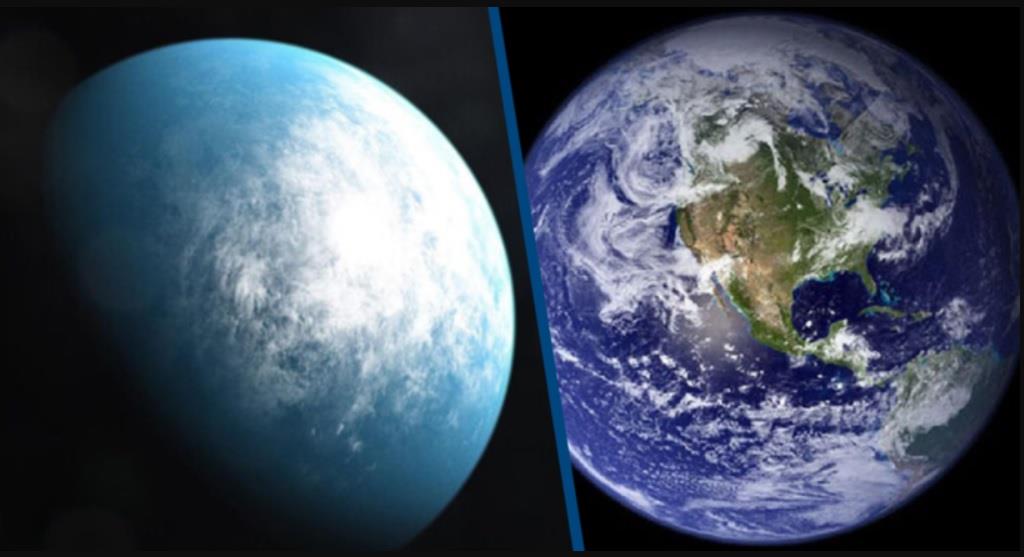
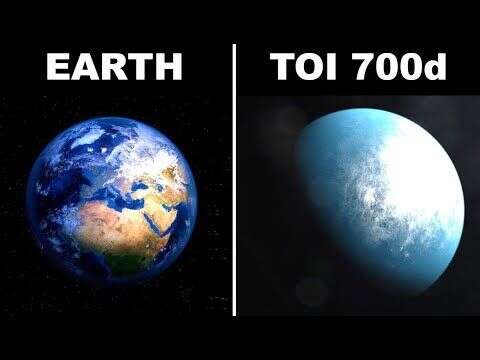
NASA has produced artistic and scientific illustrations showing possible scenarios for the planet, including simulated ocean-covered environments. These images are useful for visualizing what the world might look like, but they should not be confused with photographs of the actual planet.
If TOI 700 d has a substantial atmosphere and liquid water, its environment could potentially be very different from Earth's while still providing some of the basic ingredients considered important for life.
It is also possible that the planet is far less hospitable.
It could have lost most or all of its atmosphere. It could have a surface dominated by ice. It could possess an atmosphere that creates an extreme greenhouse effect. Or it could have geological and chemical conditions unlike anything found on Earth.
This uncertainty is precisely what makes the planet scientifically valuable.
Why TOI 700 d Matters
The importance of TOI 700 d extends beyond the possibility that life might exist there.
The discovery demonstrates how quickly astronomers are expanding the catalog of planets beyond our Solar System.
Before the first confirmed exoplanet discoveries in the 1990s, we had no direct evidence that other stars commonly hosted planets. Today, thousands of confirmed exoplanets are known, ranging from enormous gas giants to small rocky worlds.
TOI 700 d occupies an especially interesting category: a relatively small planet located in the habitable zone of a nearby star.
NASA described it as the first Earth-sized habitable-zone planet discovered by TESS, making it an important milestone for the mission and for the broader search for potentially habitable worlds.
Its relatively nearby location also makes it a valuable target for future observations.
In astronomy, "nearby" is a relative term. More than 100 light-years is unimaginably distant from a human perspective, but on the scale of the galaxy, it is considered relatively close.
That distance matters because planets around nearby stars are generally more accessible to detailed observations than planets thousands of light-years away.
The Future of the Search
The next stage in studying TOI 700 d is not sending a spacecraft there.
At a distance of more than 100 light-years, a direct mission to the system is far beyond current spaceflight capabilities. A spacecraft traveling at speeds comparable to those achieved by today's probes would require an enormous amount of time to reach it.
Instead, the immediate future of TOI 700 d research lies in remote observation.
Astronomers can use increasingly powerful space- and ground-based telescopes to study the planet's atmosphere, orbital behavior, and interaction with its star.
The James Webb Space Telescope and future observatories may help scientists investigate the atmospheres of selected small exoplanets, although the difficulty of detecting atmospheric signals from a planet as small as TOI 700 d means that such observations are technically challenging.
Future generations of telescopes could provide even greater sensitivity.
The goal is not necessarily to find a photograph showing oceans and continents.
The real objective is much more subtle: to detect chemical and physical evidence that can tell us what the planet is like.
If scientists eventually identify an atmosphere containing an unusual combination of gases that cannot easily be explained by known non-biological processes, TOI 700 d could become an even more compelling target in the search for life.
A Small World With a Very Big Question
TOI 700 d is not proof that extraterrestrial life exists.
It is not another Earth in the strict sense, and its position in the habitable zone does not guarantee oceans, breathable air, or living organisms.
What it represents is something arguably just as important: an opportunity to investigate whether Earth-like conditions can arise elsewhere.
Its discovery has shown that planets roughly comparable in size to Earth can exist in the potentially habitable regions of other planetary systems. Its host star is a cool red dwarf rather than a Sun-like star, reminding us that the search for life cannot be limited to systems that look exactly like our own.
The TOI 700 system has also become more interesting with the confirmation of a fourth planet, TOI 700 e, giving astronomers an even richer laboratory for studying how multiple planets form and evolve around a small star.
Perhaps the most exciting aspect of TOI 700 d is that we still do not know what it is truly like.
There may be no water.
There may be no atmosphere.
There may be no life.
But there is also a possibility that this distant world possesses some of the ingredients that make our own planet so extraordinary.
And that possibility is enough to make TOI 700 d an important chapter in humanity's ongoing search for life beyond Earth.
Every new potentially habitable exoplanet brings us one step closer to answering one of the oldest questions we have ever asked:
Are we alone?
TOI 700 d may not provide the answer.
But it gives us another world to look at—and another reason to keep searching.


No comments: