

Mercury is the smallest planet in the Solar System and the closest planet to the Sun. At first glance, it might seem like a simple, rocky world covered in craters. But Mercury is much more fascinating than its small size suggests.
With extreme temperatures, a surprisingly large metallic core, a very thin atmosphere, and a year that lasts only 88 Earth days, Mercury is one of the most unusual planets in our cosmic neighborhood.
Because it orbits so close to the Sun, Mercury is also one of the most difficult planets to observe from Earth. Space missions have given scientists a much better look at its surface and revealed a world with a complicated geological history.
Where Is Mercury in the Solar System?
Mercury is the first planet from the Sun. Its average distance from the Sun is about 58 million kilometers, although its orbit is not a perfect circle. Like all planets, Mercury follows an elliptical orbit, meaning its distance from the Sun changes as it travels around it.
Despite being the closest planet to the Sun, Mercury is not the hottest planet in the Solar System. That title belongs to Venus.
The reason is Mercury's atmosphere—or, more accurately, its almost nonexistent atmosphere.
Venus has a very thick atmosphere rich in carbon dioxide that traps enormous amounts of heat. Mercury, on the other hand, has an extremely thin layer of particles called an exosphere. It is far too thin to distribute or retain heat efficiently.
This creates some of the most dramatic temperature changes in the Solar System.
How Big Is Mercury?
Mercury has a diameter of approximately 4,880 kilometers, making it only slightly larger than Earth's Moon.
It is actually smaller than two moons in our Solar System: Ganymede, which orbits Jupiter, and Titan, which orbits Saturn.
Mercury's small size also means that its gravity is much weaker than Earth's. If you could somehow stand on Mercury, you would weigh only about 38% of what you weigh on Earth.
For example, a person who weighs 70 kilograms on Earth would experience a gravitational force equivalent to weighing roughly 27 kilograms on Mercury.
However, Mercury is surprisingly dense. In fact, it is the second-densest planet in the Solar System after Earth.
The main reason is its enormous metallic core.
Mercury Has a Huge Iron Core
One of the most interesting facts about Mercury is the size of its core.
Mercury's metallic core occupies a much larger proportion of the planet than Earth's core does. Scientists estimate that the core extends to roughly 85% of Mercury's radius.
The core is primarily composed of iron and other metals, and part of it remains liquid.
Why does Mercury have such a large core?
Scientists are still investigating this question. Several explanations have been proposed. One possibility is that Mercury suffered enormous collisions early in the Solar System's history that stripped away part of its rocky outer layers.
Another possibility is that Mercury formed unusually close to the Sun, where conditions favored the accumulation of metal-rich material.
There is also evidence that Mercury's core is still geologically important. The planet has a global magnetic field, although it is much weaker than Earth's.
This magnetic field provides clues about the planet's interior and suggests that at least part of Mercury's metallic core remains molten.
A Day on Mercury Is Longer Than Its Year
Mercury moves around the Sun faster than any other planet.
A complete orbit takes only 88 Earth days.
That means a year on Mercury lasts less than three months by Earth's calendar.
Its rotation is much slower.
Mercury takes about 59 Earth days to rotate once on its axis.
This unusual combination of rotation and orbital motion creates a fascinating phenomenon. Mercury has a 3:2 spin-orbit resonance, meaning that it rotates three times for every two orbits around the Sun.
Because of this relationship, a solar day on Mercury—the time from one sunrise to the next—lasts about 176 Earth days.
So although Mercury's year is very short, the interval between one sunrise and the next is twice as long as its year.
/i.s3.glbimg.com/v1/AUTH_fde5cd494fb04473a83fa5fd57ad4542/internal_photos/bs/2023/k/A/mnEagFR9AyZxnIXUYF2g/2-feature-1600x900-mercury.jpg)
The Extreme Temperatures of Mercury
Mercury experiences enormous temperature differences between its day and night sides.
During the daytime, temperatures at the surface can reach approximately 430°C.
At night, temperatures can fall to around −180°C.
That is a difference of more than 600 degrees Celsius.
The main reason for these extremes is Mercury's lack of a substantial atmosphere. On Earth, our atmosphere and oceans help move heat around the planet. Mercury has neither a thick atmosphere nor large bodies of surface liquid that can efficiently redistribute heat.
The surface can become extremely hot when exposed to direct sunlight, while the nightside loses heat rapidly into space.
Interestingly, temperatures are not equally extreme everywhere on Mercury.
Some permanently shadowed regions near the planet's poles can remain incredibly cold even though Mercury is so close to the Sun.
Ice on the Closest Planet to the Sun?
This sounds strange, but Mercury does have water ice.
Radar observations and data from spacecraft have provided strong evidence for deposits of water ice inside permanently shadowed craters near Mercury's north and south poles.
These areas are special because Mercury's axis is only slightly tilted. Some deep craters near the poles never receive direct sunlight.
Their floors can remain extremely cold, with temperatures low enough for water ice to survive for very long periods.
This discovery was one of the biggest surprises in the study of Mercury.
The planet is exposed to intense solar radiation and extreme daytime temperatures, yet some of its polar craters can preserve frozen water in permanent darkness.
Scientists believe some of this water may have been delivered by comets and water-rich asteroids over billions of years.
What Does Mercury's Surface Look Like?
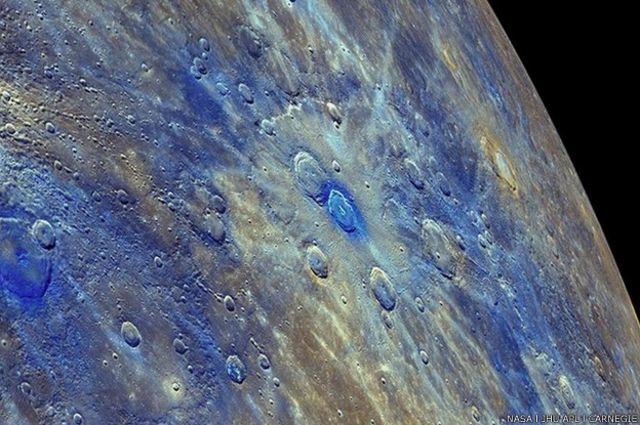
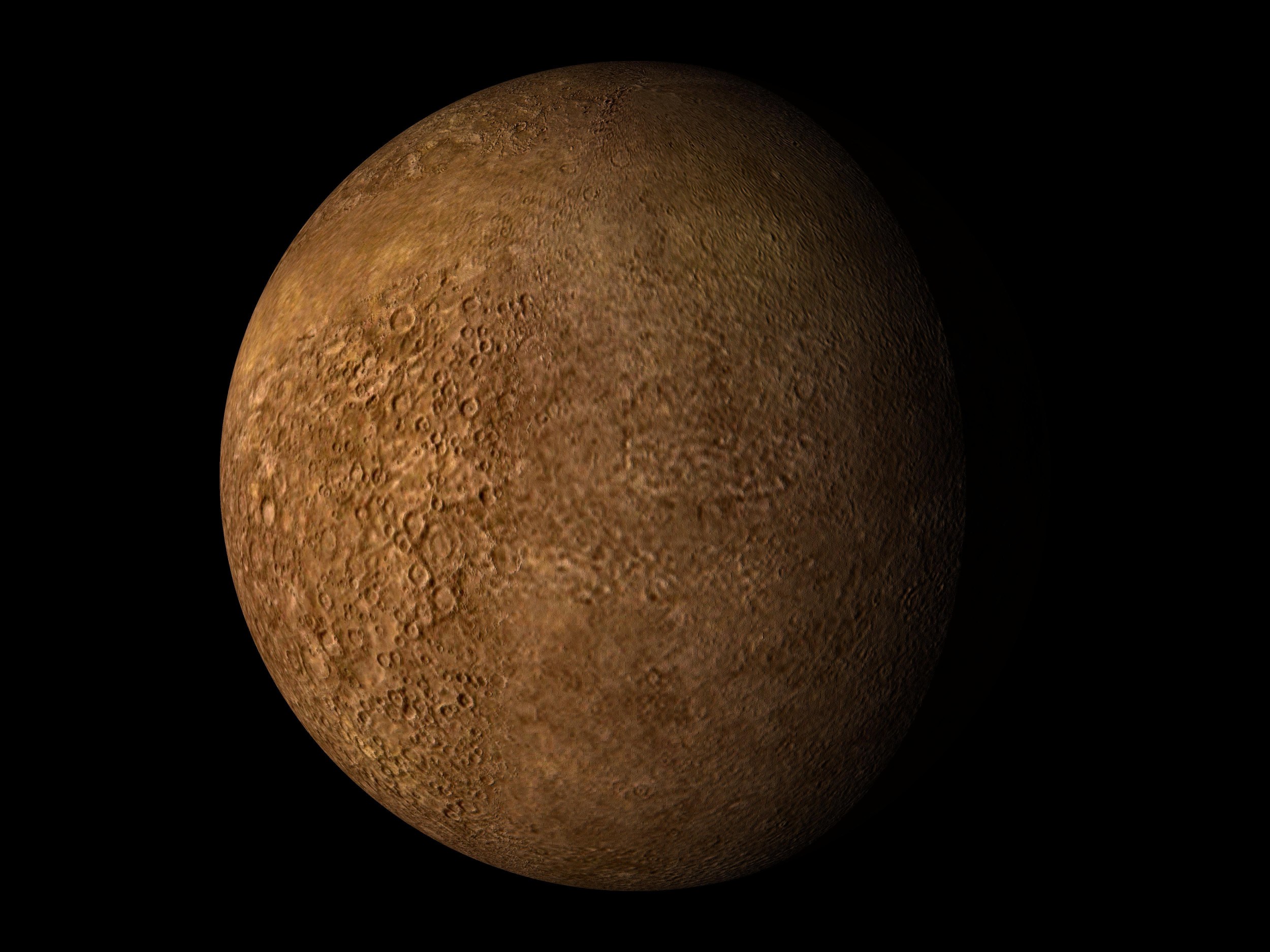
Mercury's surface looks somewhat like the Moon.
It is covered with impact craters created by collisions with asteroids and comets. Some of these craters are billions of years old, providing a record of the Solar System's violent early history.
One of Mercury's most famous features is the Caloris Basin, a gigantic impact structure approximately 1,550 kilometers across.
It was created by a massive collision early in Mercury's history.
The impact was so powerful that it affected the planet far from the original impact site. On the opposite side of Mercury, scientists found a region of unusual, heavily disrupted terrain known as chaotic terrain.
Mercury also has enormous cliffs and ridges called lobate scarps.
These formations can stretch for hundreds of kilometers and rise several kilometers above the surrounding terrain.
They formed as Mercury's interior gradually cooled and the planet contracted. As the planet became slightly smaller, sections of the crust were pushed together, producing large faults and cliffs.
This tells scientists that Mercury was not simply a dead, frozen rock. Its surface has changed significantly over geological time.
Mercury's Thin Exosphere
Mercury does not have a normal atmosphere like Earth.
Instead, it has an extremely thin exosphere, made up of atoms and molecules that are so sparse that they rarely collide with one another.
The exosphere contains elements such as oxygen, sodium, hydrogen, helium, and potassium.
Some of these particles are released from Mercury's surface by solar radiation, micrometeorite impacts, and other processes.
Because the exosphere is so thin, it cannot provide the protection or heat retention that Earth's atmosphere provides.
It also means that Mercury's surface is directly exposed to the harsh environment of space.
Does Mercury Have a Magnetic Field?
Yes. Mercury has a global magnetic field.
This was first discovered by NASA's Mariner 10 spacecraft during its encounters with the planet in the 1970s.
The magnetic field is much weaker than Earth's, but its existence is extremely important to planetary scientists.
Mercury's magnetic field is believed to be generated by movement within its partially molten metallic core, through a process known as a dynamo.
Earth's magnetic field is also produced by movements in its liquid outer core.
Studying Mercury's magnetic field helps scientists understand what is happening deep beneath the planet's surface and how small rocky planets evolve over billions of years.
How Was Mercury Explored?
Mercury is difficult to visit with a spacecraft because of its proximity to the Sun.
A spacecraft traveling toward Mercury has to deal with intense solar radiation and, surprisingly, must lose a tremendous amount of orbital energy to enter Mercury's orbit.
The first spacecraft to visit Mercury was Mariner 10, launched by NASA in 1973.
It made several flybys of the planet and became the first spacecraft to use a gravitational assist from another planet. Mariner 10 photographed roughly 45% of Mercury's surface.
Decades later, NASA's MESSENGER mission provided a much more complete picture.
MESSENGER entered orbit around Mercury in 2011 and spent several years studying the planet's surface, interior, magnetic field, exosphere, and polar regions.
The mission revealed thousands of previously unknown geological features and provided important evidence for water ice near Mercury's poles.
BepiColombo and the Next Chapter of Mercury Exploration
The European Space Agency and the Japan Aerospace Exploration Agency are working together on the BepiColombo mission.
Launched in 2018, BepiColombo consists of two scientific orbiters: ESA's Mercury Planetary Orbiter and JAXA's Mercury Magnetospheric Orbiter, also known as Mio.
The spacecraft has been using a complex series of planetary flybys to gradually adjust its trajectory and enter orbit around Mercury.
BepiColombo is designed to investigate Mercury's geology, magnetic field, interior structure, exosphere, and interaction with the solar wind.
One of the major goals is to understand why Mercury developed such a large metallic core and how the planet evolved so differently from Earth and other rocky worlds.
Why Mercury Is Important for Understanding Rocky Planets
Mercury may be small, but it provides scientists with a valuable natural laboratory.
Earth, Venus, Mars, and Mercury are all rocky planets, yet they evolved in very different ways.
Earth developed abundant surface water and a life-supporting atmosphere. Venus became a world with a massive carbon dioxide atmosphere and extreme surface temperatures. Mars lost most of its atmosphere and became a cold desert.
Mercury followed another path.
It retained a huge metallic core, developed a weak magnetic field, lost most of its atmosphere, experienced enormous temperature variations, and preserved ancient geological features on its surface.
By studying Mercury, scientists can better understand how rocky planets form, how their interiors evolve, how magnetic fields develop, and how planets change over billions of years.
For students and anyone curious about astronomy, Mercury is a reminder that planetary science is not simply about memorizing the order of the planets. Every world has its own history, chemistry, geology, and mysteries—and even the smallest planet can reveal important clues about how the Solar System came to be.


No comments: