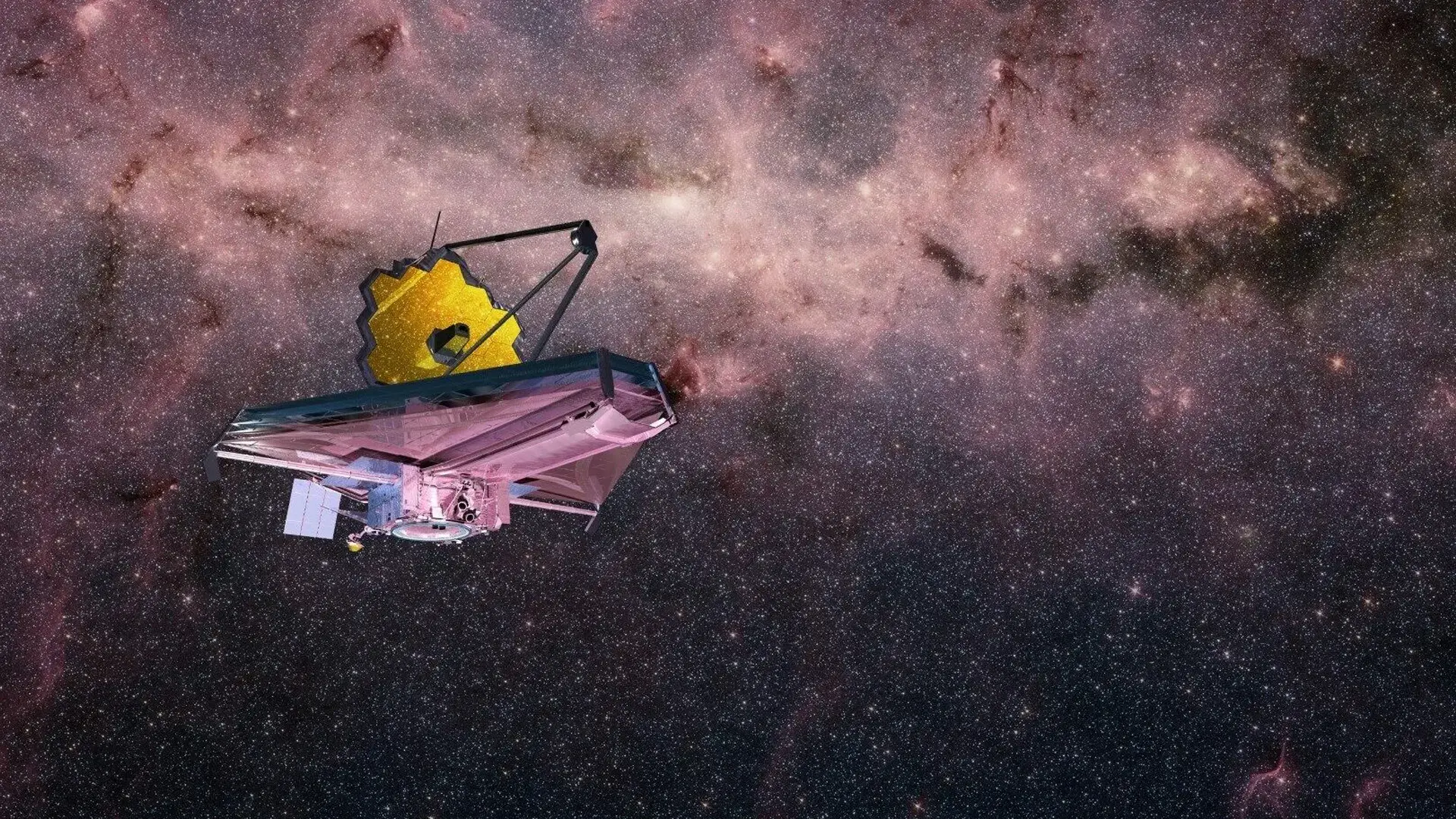
There are moments in science that divide history into two distinct chapters: before the discovery and after it. The invention of the telescope by Galileo in the early 17th century was one of those moments. For the first time, humanity realized that the Moon was scarred with mountains and craters, Jupiter was surrounded by moons of its own, and the heavens were far more dynamic than anyone had imagined.
More than four centuries later, another telescope is transforming our understanding of the cosmos with a similar sense of wonder. The James Webb Space Telescope, often shortened to JWST, isn't simply a more powerful replacement for Hubble. It represents a completely different way of looking at the universe, allowing astronomers to peer through clouds of cosmic dust, study the atmospheres of distant worlds, and observe galaxies that formed when the universe was still in its infancy.
Since its first images were released, Webb has repeatedly exceeded expectations. It has revealed structures that were previously invisible, challenged long-standing theories about galaxy formation, and offered tantalizing clues about planets orbiting distant stars. Each new observation seems to raise as many questions as it answers, reminding us that the universe is far more complex than our models predicted.
What makes these discoveries remarkable isn't just the telescope's incredible engineering. It's the realization that many of the assumptions astronomers held for decades are now being reconsidered in light of what Webb continues to uncover.
A Telescope Unlike Any Before It
To understand why Webb has had such a dramatic impact, it's worth asking a simple question: why wasn't Hubble enough?
For more than thirty years, the Hubble Space Telescope revolutionized astronomy. Its breathtaking images became icons of modern science, inspiring millions of people while helping researchers measure the expansion of the universe, study black holes, and observe distant galaxies with unprecedented clarity.
Yet Hubble has one important limitation. It primarily observes visible and ultraviolet light, the same part of the electromagnetic spectrum that our own eyes can detect. While this works beautifully for many astronomical targets, it leaves enormous portions of the universe hidden behind curtains of dust.
Webb was designed to solve that problem. Instead of focusing mainly on visible light, it observes the cosmos in infrared wavelengths. Infrared light has a remarkable ability to pass through clouds of gas and dust that block ordinary light, revealing regions of space that have remained hidden for billions of years.
Imagine standing outside on a foggy morning. Your eyes struggle to see beyond the mist, but certain infrared cameras can detect objects concealed behind it. Webb works on a similar principle, except the "fog" it penetrates consists of enormous clouds of cosmic dust spread across entire galaxies.
This single difference has fundamentally changed what astronomers can observe.
Building an Observatory That Almost Never Worked
Creating the James Webb Space Telescope required decades of planning, engineering, and no small amount of courage.
The project officially began in the 1990s, but its roots stretch back even further, to discussions about what should follow Hubble. Engineers envisioned a telescope with a mirror far larger than anything previously launched into space. The problem was obvious: no rocket fairing was large enough to carry such an enormous mirror.
The solution seemed almost impossible. Instead of building one giant mirror, Webb would use eighteen hexagonal segments made from beryllium, each coated with an incredibly thin layer of gold. Once in space, these individual pieces would unfold and align with extraordinary precision, behaving as a single mirror measuring 6.5 meters across. Every stage of deployment represented a potential point of failure.
The telescope had to unfold hundreds of moving components after launch without any possibility of astronauts repairing them. Unlike Hubble, which orbits relatively close to Earth, Webb would travel nearly 1.5 million kilometers away to a location known as the second Lagrange point, or L2. At that distance, servicing missions are currently impossible.
Engineers sometimes referred to the deployment process as containing "hundreds of single points of failure." If just one critical mechanism became stuck, decades of work—and billions of dollars—could have been lost.
When Webb launched aboard an Ariane 5 rocket on Christmas Day in 2021, scientists around the world celebrated. Yet many admitted they wouldn't fully relax until every mirror segment, antenna, instrument, and sunshield had unfolded successfully.
Over the following weeks, one of the most complex engineering sequences ever attempted in space unfolded almost flawlessly. It remains one of NASA's greatest technological achievements.
Why Gold Covers Webb's Mirror
One of the telescope's most recognizable features is its golden mirror.
To someone unfamiliar with astronomy, the gold coating might appear decorative or symbolic, but it serves a highly practical purpose.
Gold is exceptionally efficient at reflecting infrared light.
Because Webb observes primarily in infrared wavelengths, a microscopic coating of gold dramatically improves its performance. Surprisingly, the amount of gold used across the entire mirror is incredibly small—only a few dozen grams, spread into an extraordinarily thin layer.
The mirror itself isn't actually made of gold. Its structural material is beryllium, chosen because it remains extremely stable even at temperatures close to absolute zero.
Maintaining stability is essential.
If the mirror were to expand or contract unevenly as temperatures changed, its images would become blurred. Every observation depends on the mirror maintaining its precise shape with astonishing accuracy.
This level of engineering allows Webb to detect incredibly faint light that has traveled across the universe for more than thirteen billion years.
Looking Back Through Time
One of the most fascinating ideas in astronomy is that telescopes function as time machines. This isn't science fiction. Because light travels at a finite speed, everything we observe appears as it existed when that light began its journey.
When you look at the Moon, you're seeing it approximately 1.3 seconds in the past. The Sun appears as it was about eight minutes ago. The nearest star beyond our solar system is seen more than four years in the past. As distances increase, so does the journey undertaken by light.
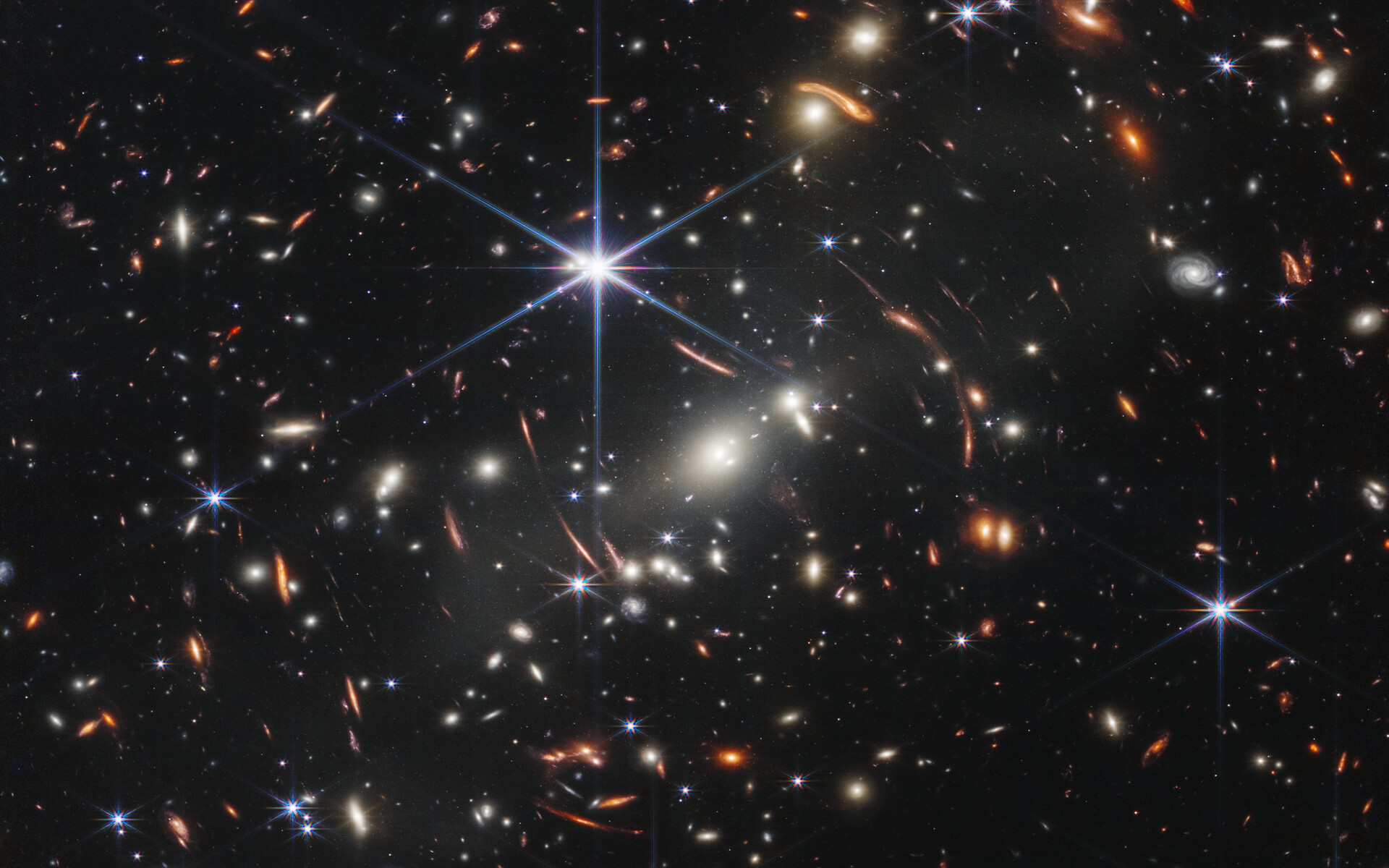
Many of the galaxies photographed by Webb emitted the light we see today more than thirteen billion years ago, when the universe itself was only a few hundred million years old. In other words, Webb isn't merely observing distant galaxies. It is observing the earliest chapters of cosmic history.
This capability has already transformed one of astronomy's biggest questions: how quickly did galaxies begin to form after the Big Bang?
For years, computer simulations suggested that the first galaxies would have been relatively small, irregular, and slow to evolve. Researchers expected the early universe to look somewhat chaotic, with primitive structures gradually merging into the magnificent spiral and elliptical galaxies we see today.
Instead, Webb found something astonishing. Some of the earliest galaxies appear far brighter, larger, and more organized than existing models predicted. Their stars seem to have formed rapidly, suggesting that galaxy evolution may have progressed much faster than astronomers once believed. The discovery doesn't necessarily overturn modern cosmology, but it has forced scientists to revisit assumptions that had seemed well established for decades. And that has become one of Webb's defining characteristics.
Rather than confirming everything astronomers expected to find, it has repeatedly reminded us that nature rarely follows our predictions as neatly as we'd like.


No comments:
Post a Comment